Cultural History and Significance from the Mountains of Guizhou
Baby Carriers of the Miao-Hmong
Cultural History and Significance from the Mountains of Guizhou
A People and a Place
The Miao, known beyond China as the Hmong, are believed to be among the earliest indigenous peoples of China. Over many centuries, repeated conflicts with expanding Han Chinese populations pushed them southwest into the rugged mountains of present-day Guizhou Province, where they remain concentrated today, alongside related communities in Yunnan, Sichuan, and Hunan, and across the borders into Vietnam, Laos, Thailand, and the worldwide Hmong diaspora. Within Guizhou, the Miao are organized into many subgroups distinguished by dress and embroidery style. The baby carrier, known as the meibei, stands as one of the most concentrated expressions of their textile artistry and worldview.
A Mother’s First Great Work
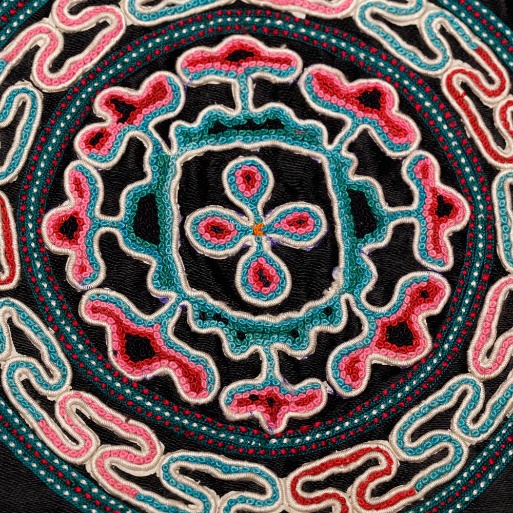
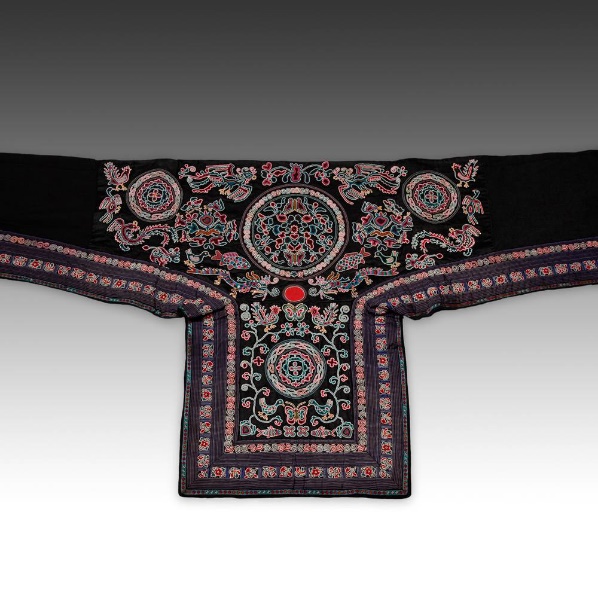 Miao girls traditionally begin learning embroidery from their mothers around the age of seven or eight, and the baby carrier is often the first major project they undertake for the children they will one day bear. A fine carrier can take years to complete, with every stage carried out by hand: raising silkworms for thread, growing and weaving cotton or hemp for the ground cloth, dyeing it in indigo or batik with maple-resin resist, and finally embroidering the central panel and shoulder straps in dense, jewel-bright stitches. The finished textile, with its four corners tied across the wearer’s chest, holds the infant high on the mother’s back so she can work in the fields with the child close to her heartbeat.
Embroidery as Memory and Prayer
Because the Miao historically had no written script, embroidery became their archive. Each motif carries the memory of an ancestor, a migration, or a creation story. The Butterfly Mother, born from an ancient maple tree, is said to have laid twelve eggs that gave rise to humankind and is invoked on baby carriers to bless the child with health and the mother with fertility. Dragons, in a softer, friendlier form than the imperial Chinese version, offer protection. Birds, fish, peonies, pomegranates, and the four-petaled tongzi flower of the Guizhou mountains stand for prosperity and abundance. Swirling whirlpool patterns recall the great rivers crossed during the Miao’s long migration south from the Yellow River basin to their present home.
Regional Styles and Techniques
Different Miao subgroups produce strikingly different carriers. Zhijin county is famous for the chanxiu wrapping stitch, an exceptionally challenging technique that builds dense, raised motifs of the tongzi flower. Leishan and Danzhai are renowned for fine-line maple-resin batik, while Shidong on the Qingshui River specializes in carriers featuring the Butterfly Mother. Silk, cotton, and even fine horsehair are used as embroidery thread, and Miao embroidery as a whole was inscribed on China’s national list of intangible cultural heritage in 2006.
Significance Beyond the Object
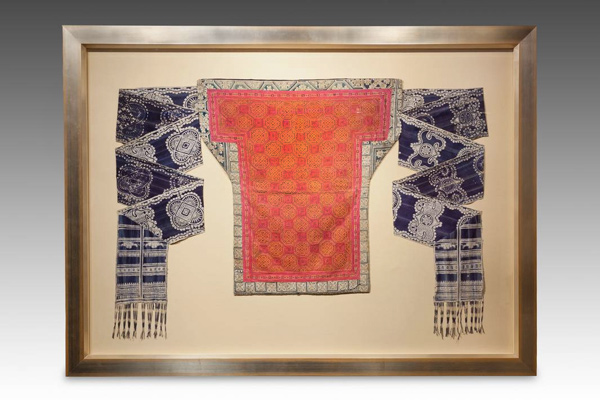 A Miao baby carrier is therefore far more than a practical garment. It is a maternal love letter, a ritual amulet, and a portable history book all at once, carrying the child wrapped in the protection of ancestors, deities, and the long memory of a wandering people. Today these textiles are increasingly collected by museums and admirers worldwide, even as Miao women continue to stitch them at home, ensuring that the next generation begins life enfolded in the same threads of meaning.