History and Significance of a West African Weaving Tradition
Ewe Cloth
History and Significance of a West African Weaving Tradition
The Ewe People and Their Homeland
The Ewe pronounced “Ev-ay,” are a West African people who live around the Volta delta of southeastern Ghana and across the international border in southern Togo. According to their own oral histories, several groups reached this region in the seventeenth century after a series of migrations from the east, passing through the historic town of Notse in present-day Togo. Unlike the Ashanti to the west, the Ewe were never unified under a single powerful kingdom; they were governed instead by numerous village chiefs and shrine priests. This decentralized political life shaped a weaving tradition that is exceptionally diverse, since no central court imposed a single standard of design.
Origins of the Weaving Tradition
Ewe oral tradition traces the craft back to the sixteenth century, carried by weavers among the migrants who resettled in Ghana from the Benin Republic and western Nigeria. The traditional Ewe name for the cloth is agbamevo, formed from agba (loom) and avo (cloth). By the eighteenth century, the coastal town of Keta had become a major weaving center, and the earliest written description of southern Ewe weaving comes from a 1718 report by a Dutch West India Company official visiting Keta. By the late nineteenth century, the craft had also taken deep root among the northern Ewe living above the Volta River, with Kpetoe emerging as another important hub.
Technique and Visual Character
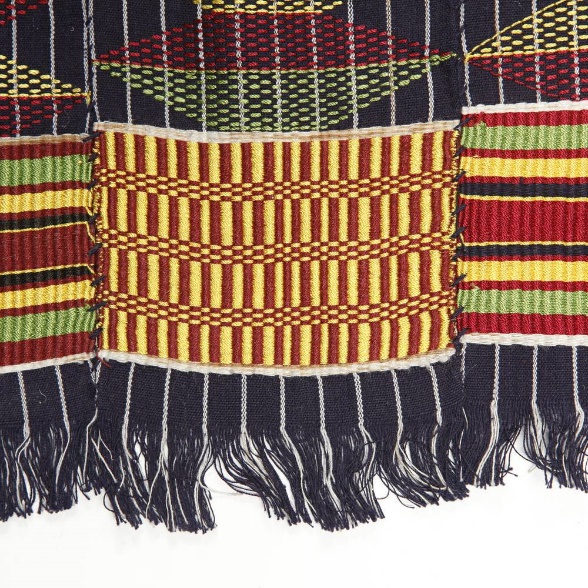 Ewe weavers use a narrow-strip treadle loom almost identical to the Ashanti loom, producing long bands that are then cut and stitched edge to edge into a complete cloth. Where Ashanti kente favors silk or rayon and bold non-figurative geometry, Ewe cloth is best known for its cotton ground and its remarkable repertoire of figurative imagery. A distinctive type known as adanudo features richly inlaid weft-float pictures of cows, sheep, horses, ceremonial stools, hats, trees, household tools, and human figures, set against silk, rayon, or cotton backgrounds. Simpler Ewe cloths, often in indigo and white geometric patterns, were everyday wear; the most elaborate were ceremonial.
Meaning, Use, and Significance
 Within Ewe culture, cloth functions as a visual record of history, oral literature, philosophy, moral teaching, religious belief, and rules of social conduct. Patterns and colors carry layered meanings, and certain cloths appear in shrines as markers of spiritual presence. Worn by chiefs, priests, and ordinary community members alike, Ewe textiles mark naming ceremonies, marriages, festivals, and funerals. Many collectors and textile scholars regard Ewe weaving as the highest expression of African woven artistry precisely because of its narrative range and technical virtuosity.
Recognition Today
Although Ewe weaving is less internationally famous than Ashanti kente, the two traditions have long influenced one another, and Ewe cloth has also shaped the textile arts of the Fon of Benin and the Yoruba of Nigeria. In December 2024, UNESCO inscribed kente, the broader hand-woven tradition shared by both Ewe and Akan weavers, on its Representative List of the Intangible Cultural Heritage of Humanity, formally recognizing the Ewe contribution alongside that of the Ashanti and securing the craft’s standing for future generations.
From the collection of Ewe Cloth – Primitive – Chicago