The Horse on the Roof of the World
The Tibetan Saddle Horse Blanket: History and Significance
The Horse on the Roof of the World
Few cultures have prized the horse as deeply as the Tibetans. Across the high plateaus of Tibet, where vast distances, thin air, and harsh terrain shaped daily life for centuries, horses were essential to herders, traders, pilgrims, monks, and soldiers alike. The annual horse festivals at Litang, Yushu, and Nagchu drew thousands of riders to compete in races, archery, and feats of mounted skill. Within this equestrian world, the saddle blanket, known as a makden or simply tsuktruk, was both an indispensable working textile and one of the most artistically sophisticated weavings produced anywhere in the Himalayan region.
Form and Construction
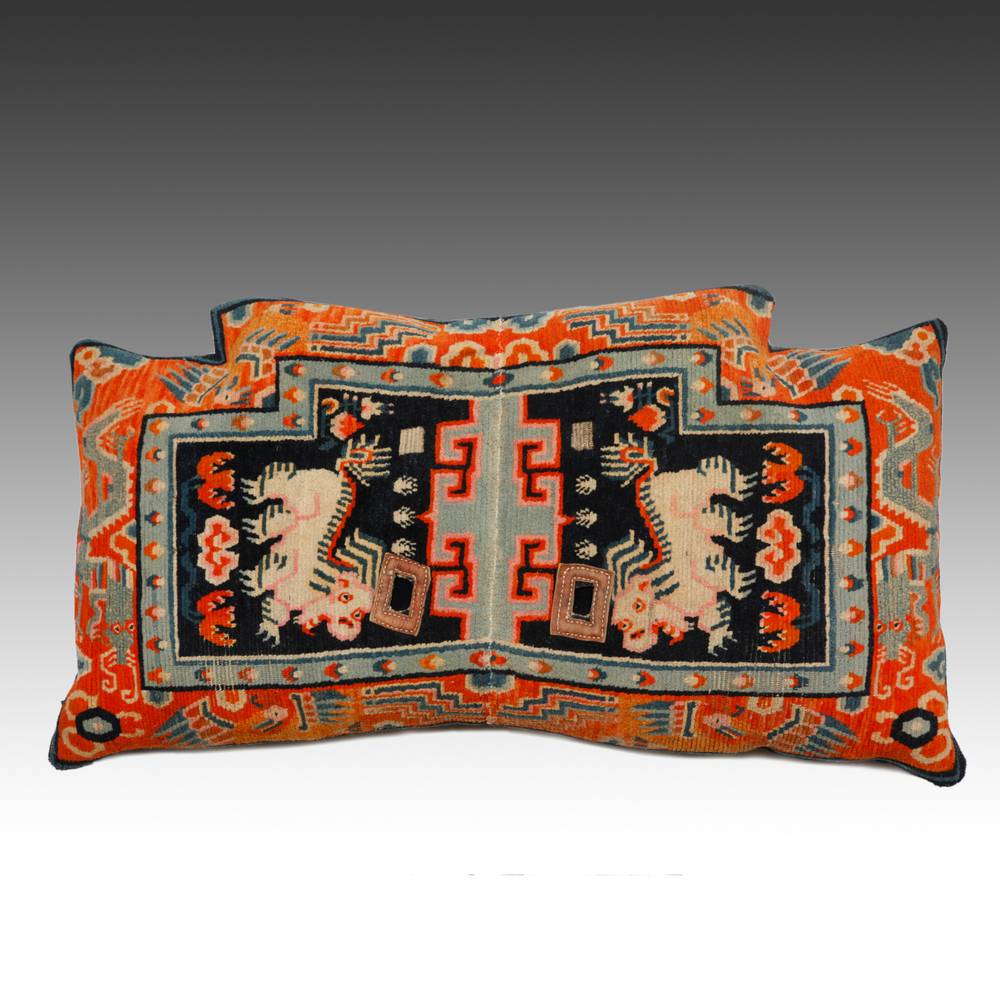
The classic Tibetan saddle set consists of two parts. The under-blanket, or makden, is a larger rectangular pad placed directly on the horse’s back to cushion the wooden saddle and protect the animal from chafing. The top cover, called a makdzi, is a smaller, often more lavishly decorated piece laid over the saddle itself. Both are woven from highland sheep’s wool or yak hair on narrow back-straps or horizontal looms. The pile rugs of central Tibet, particularly those from Wangden, Gyantse, and Shigatse, employ a distinctive cut-loop technique that produces a thick, durable surface ideal for the rigors of mounted travel. Natural dyes derived from madder, indigo, walnut, and rhubarb root yielded the rich palette of reds, blues, golds, and earth tones that distinguish antique Tibetan examples.
 Designs and Symbolism
Tibetan saddle blankets are renowned for the inventiveness of their designs. Common motifs include lotus blossoms, peonies, dragons, phoenixes, swirling clouds, and the eight auspicious Buddhist symbols, alongside geometric medallions and stylized tiger stripes. The tiger pelt design held particular spiritual weight, evoking the meditation seats of tantric saints and conveying ferocity, protection, and royal status. Many pieces drew on Chinese visual conventions absorbed through centuries of trade and political exchange, while others retained an unmistakably Tibetan boldness of color and rhythm. A finely woven blanket served as a visible declaration of the rider’s wealth, taste, and social standing.
Significance and Legacy
Beyond utility and ornament, saddle blankets played a role in religious and ceremonial life. High lamas traveled by horse on circuits between monasteries, and aristocratic families commissioned elaborate sets for weddings, festivals, and diplomatic occasions. The weavings were also among the most valued items of trade with neighboring Bhutan, Mongolia, and Nepal. Following the upheavals of the mid-twentieth century, many fine examples entered Western collections, where they are now studied as masterpieces of Himalayan textile art. Today the Tibetan saddle blanket remains a vivid emblem of a horse-bound culture in which beauty, faith, and survival were woven tightly together on a single loom.