Origins of the Laughing Monk
Hotei, the Laughing Buddha: History and Significance
Origins of the Laughing Monk
The figure popularly known as the Laughing Buddha originates not from the historical Buddha Shakyamuni, but from a beloved Chinese Buddhist monk named Budai, who lived during the Later Liang dynasty in the early tenth century. He is known in Japan as Hotei, in Korea as Podae, and in Vietnam as Bố Đại. According to traditional accounts, Budai was an eccentric Chan Buddhist monk who wandered the countryside of Zhejiang Province carrying a large cloth sack from which he distributed sweets, toys, and small treasures to children. His name literally means “cloth sack,” a reference to this ever-present bag. Despite his unconventional behavior, Budai was widely revered for his wisdom, kindness, and infectious laughter, and after his death he was gradually identified as an incarnation of Maitreya, the Buddha of the future.
Iconography
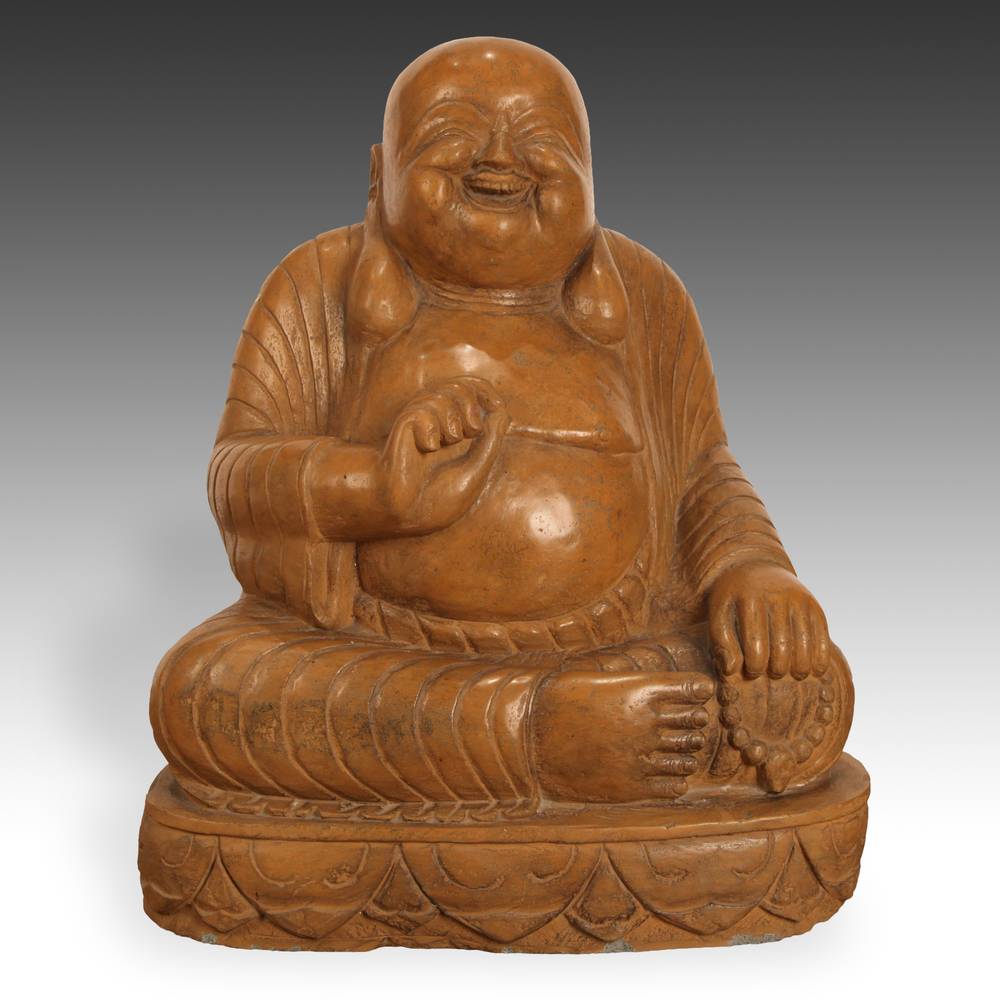 The visual conventions of Hotei are unmistakable. He is depicted as a stout, smiling man with an exposed round belly, signifying happiness, abundance, and contentment. His robe hangs loosely, and his sack rests beside him filled with the troubles he has gathered from those he meets, or alternatively with the blessings he is ready to bestow. He often holds a string of prayer beads or a wish-fulfilling gourd. In some depictions he is surrounded by playful children, in others by ingots of gold, and in others he raises both arms above his head in a gesture of triumphant joy. His laughter is regarded as a teaching, an embodiment of the Chan principle that enlightenment can flow from a heart freed of worldly attachment.
Cultural and Spiritual Significance
In East Asia, Hotei occupies a unique position bridging formal Buddhism and popular folk religion. Within Buddhist temples he is venerated as Maitreya, the bodhisattva who will appear in the distant future to renew the dharma. In domestic settings he is treated as a spirit of prosperity, generosity, and good fortune. In Japanese tradition Hotei is one of the Seven Lucky Gods, or Shichifukujin, and he is associated specifically with happiness, abundance, and the wellbeing of the family. His statue is commonly placed in homes where rubbing his belly is believed to bring luck and ward off misfortune.
Enduring Legacy
Today the Laughing Buddha is one of the most widely recognized religious images in the world, sculpted in jade, wood, brass, porcelain, and resin and exported across the globe. While Western audiences sometimes confuse him with Shakyamuni, he remains a distinct and cherished figure whose joyous form continues to symbolize generosity, openheartedness, and the simple, profound wisdom of finding contentment in everyday life.