The Goddess of Transcendent Wisdom
Prajnaparamita as Ken Dedes: History and Significance
The Goddess of Transcendent Wisdom
Prajnaparamita is one of the most revered figures in Mahayana Buddhism, personifying the Perfection of Wisdom, the insight that pierces through illusion and reveals the true nature of reality. Her name combines the Sanskrit prajna, meaning wisdom, with paramita, meaning perfection or transcendence. She is regarded as the spiritual mother of all Buddhas, since enlightenment itself is born from the wisdom she embodies. Across Asia she is depicted seated in meditation, hands forming the dharmachakra mudra of teaching, often holding a lotus that supports a sacred manuscript representing the Prajnaparamita Sutras.
Ken Dedes and the Singhasari Kingdom
In thirteenth-century Java, the worship of Prajnaparamita took on a uniquely Indonesian character through her association with Ken Dedes, the celebrated queen consort of Ken Arok, founder of the Singhasari kingdom in 1222. According to the Pararaton, a Javanese chronicle, Ken 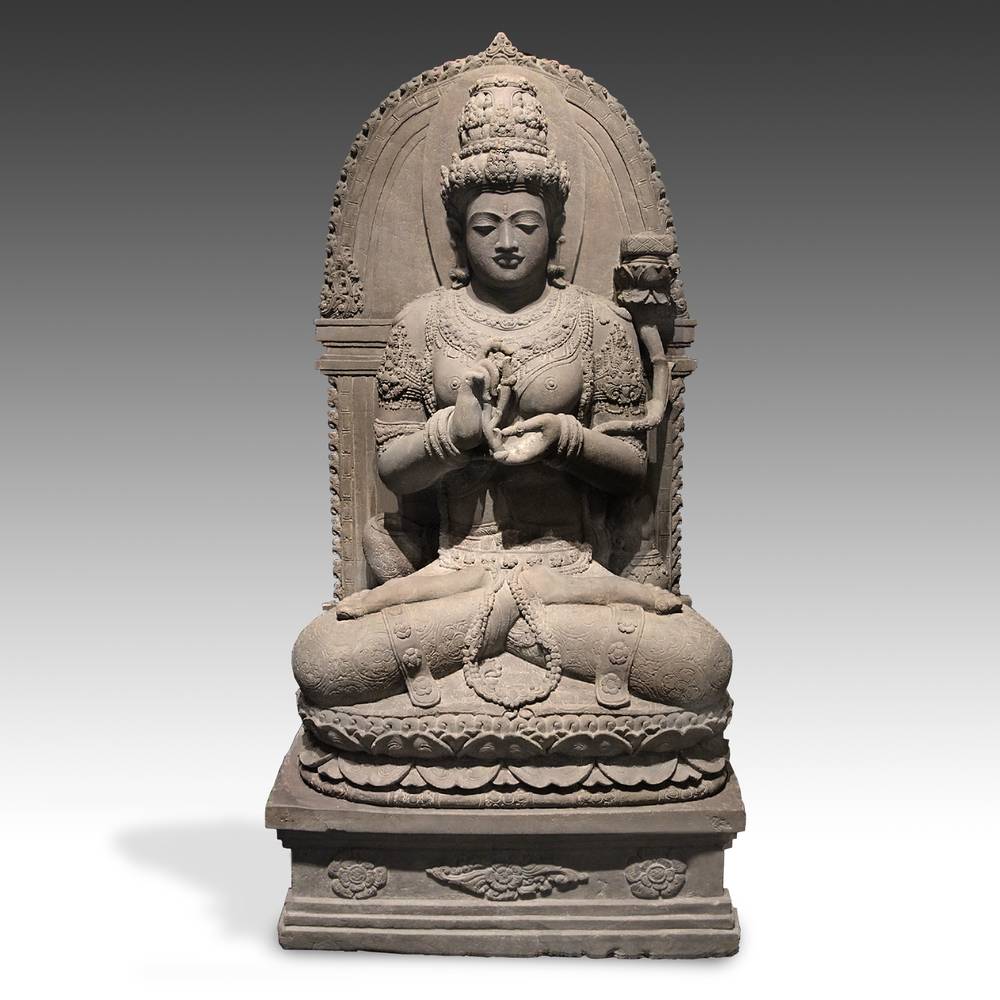 Dedes was a woman of such radiant beauty and spiritual power that a Brahmin foretold she would become the mother of kings. Her marriage to Ken Arok established a royal line that would eventually produce the Majapahit dynasty, the greatest Hindu-Buddhist empire in Southeast Asian history. After her death, Ken Dedes was deified and commemorated as a manifestation of Prajnaparamita, blending the Buddhist concept of transcendent wisdom with Javanese ideals of sacred queenship.
The Singhasari Statue
The most famous artistic embodiment of this fusion is the stone statue of Prajnaparamita discovered in the ruins of Cungkup Putri near Singhasari, East Java, in 1818 or 1819. Carved from a single block of andesite, the figure sits in lotus posture upon a lotus throne, her hands in the gesture of teaching, her face composed in serene meditation. The exquisite detail of her jewelry, headdress, and the intricate floral ornamentation on the back panel mark it as a masterpiece of classical Javanese sculpture. Long believed to be the funerary portrait of Ken Dedes herself, the statue captures the moment when an earthly queen merges with a cosmic deity.
Cultural Legacy
Taken to the Netherlands during the colonial era, the statue was displayed at the Rijksmuseum Volkenkunde in Leiden until 1978, when it was returned to Indonesia and installed in the National Museum in Jakarta. Today it stands as a national treasure, symbolizing both the height of Javanese artistic achievement and the enduring image of the wise, powerful woman as ancestor of kings, embodiment of wisdom, and spiritual guardian of the archipelago.