The Island of Sumba and Its Weavers
The Hinggi Kombu of Sumba: History and Significance
The Island of Sumba and Its Weavers
The hinggi kombu is a magnificent ceremonial mantle woven on the island of Sumba in eastern Indonesia, part of the East Nusa Tenggara province. Sumba is renowned across the world for its textile arts, and East Sumba in particular, with the regions around Kanatang, Kaliuda, and Rindi, has long been the heartland of hinggi production. The garment is traditionally worn by men in pairs, one wrapped around the waist as a kain and the other draped across the shoulder as a selendang. Together they form one of the most striking expressions of male attire anywhere in the archipelago, signaling identity, lineage, and rank in a society once organized around aristocratic clans, warriors, and sacred ancestors.
Ikat and the Meaning of Kombu
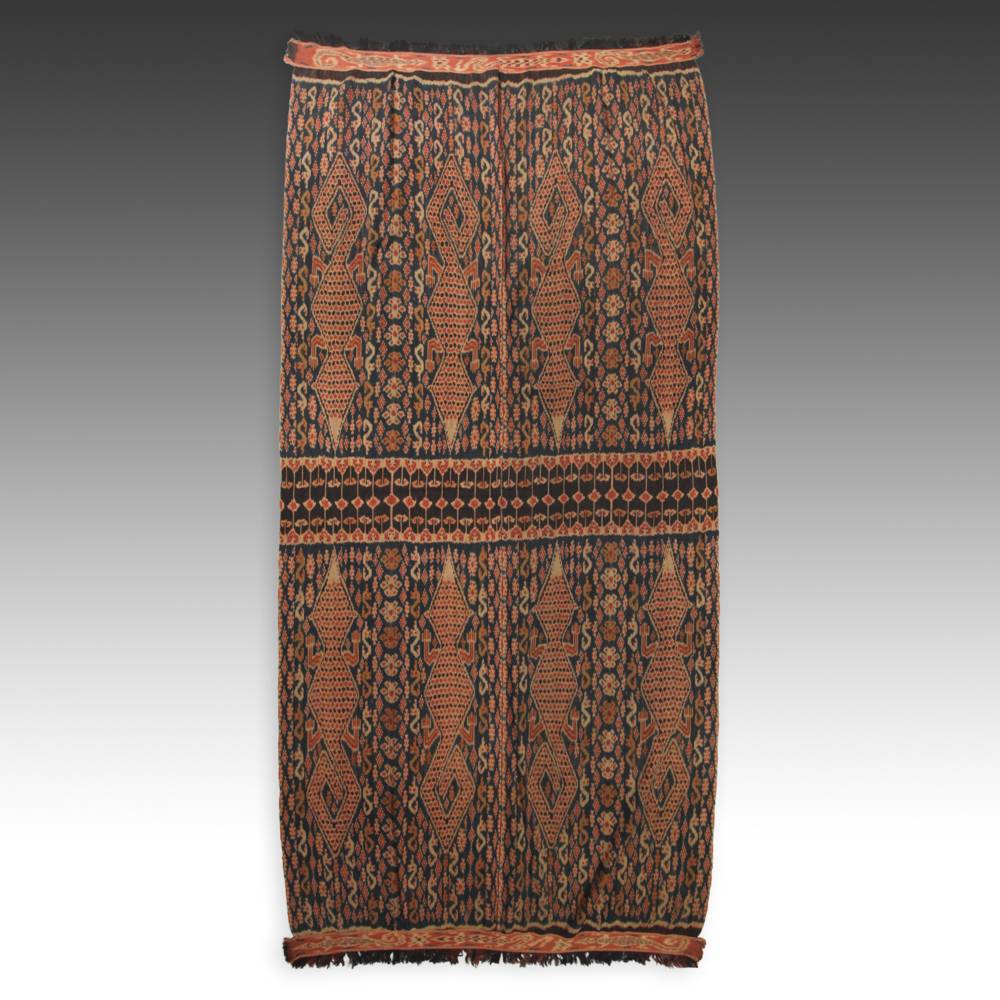 The hinggi is produced using warp ikat, an exacting resist-dye technique in which patterns are tied into the warp threads with palm leaf strips before weaving begins. Each thread is dyed multiple times, with the binding adjusted between each immersion to build complex multicolored designs. The word kombu refers to the deep red dye derived from the roots of the morinda tree, a color obtained only through repeated dyeing over many months and traditionally regarded as the most spiritually potent. A finished hinggi kombu typically combines this rich red with indigo blue and cream-white in bold, mirrored compositions. Producing a single pair can take a year or more, and the finest examples are the work of master women weavers whose skills are passed from mother to daughter.
Iconography and Status
The motifs woven into a hinggi form a vocabulary of power and prestige. Horses celebrate the noble caste and Sumbese horsemanship, while crocodiles, lions, and deer signal strength and lineage. Most striking is the andung, a tree hung with severed human heads, recalling the era when headhunting was a sacred component of warfare and male initiation. Skull trees, roosters, and shrimp also recur, each carrying mythological meaning. In the past, only members of the aristocratic maramba class were permitted to wear cloths bearing certain animal motifs, and the right to commission such a textile was itself a marker of high birth.
Ritual Role and Legacy
Beyond daily prestige, the hinggi kombu plays an essential role in funerary rites. Sumbese tradition holds that the dead must be wrapped in many layers of fine cloth to ensure their successful journey to the ancestral realm of Marapu, and a nobleman might be buried in dozens of textiles. Hinggi are also exchanged as bride wealth, ratifying alliances between clans. Today the cloths are admired internationally and held in major museum collections, while in Sumba itself the tradition continues to evolve, sustaining both cultural identity and the livelihoods of contemporary weaving communities.