The Asmat of Irian Jaya
The Jipae Ceremonial Body Mask of the Asmat People
The Asmat of Irian Jaya
The jipae is a ceremonial body mask created by the Asmat people, who inhabit the swampy lowlands and mangrove forests of southwestern Irian Jaya, the Indonesian half of the island of New Guinea (now officially known as Papua). For centuries the Asmat lived in near-total isolation, sustained by sago palm harvesting, fishing, and hunting. Their cosmology centers on a profound and inseparable bond between the living and the dead, and almost every major art form they produce, from towering bisj poles to hand drums and shields, exists to mediate that relationship. The jipae mask is among the most powerful expressions of this worldview.
Construction and Form
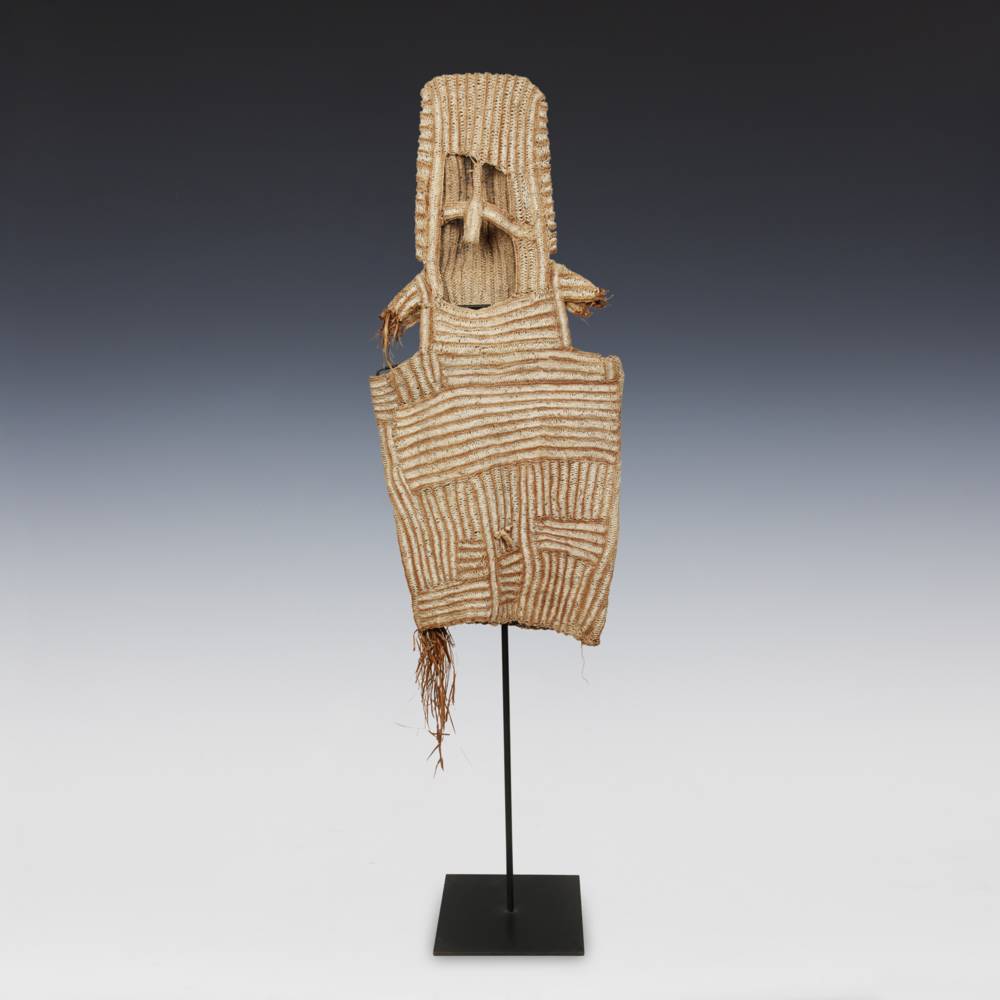 Unlike a face mask, the jipae is a full-body costume that completely envelops the wearer from head to ankle. It is woven from sago palm fiber and rattan into a tight, sleeve-like net, with cuffs of cassowary feathers at the wrists and a dense skirt of fibers at the base. The conical hood is decorated with shells, seeds, Job’s tears, and tufts of feathers, and a carved wooden face emerges at the front. Each mask is painstakingly produced in secret by male artisans inside the men’s ceremonial house, or jeu, and the techniques are passed orally from generation to generation.
Ritual Significance
The jipae is worn during the Jipae feast, a major mortuary ceremony held to honor those who have died since the previous celebration. Asmat belief holds that the spirits of the dead linger restlessly in the village, disturbing the living and threatening the community’s well-being. During the ritual, masked dancers embody these ancestral spirits, moving through the village and entering the houses of the deceased’s relatives. The maskers symbolically take on the role of the dead, allowing surviving family members to grieve, settle obligations, and formally release the spirits toward Safan, the Asmat land of the ancestors situated beyond the western sea. After the ceremony concludes, the village is considered cleansed and balance is restored.
Legacy
Following sustained contact with missionaries and government authorities in the mid-twentieth century, traditional Asmat ceremonies were suppressed, and many jipae masks entered Western Museum collections, including those of the Metropolitan Museum of Art and the Tropenmuseum. Today, the Asmat have reclaimed and revitalized their carving traditions, and the jipae remains a potent symbol of cultural resilience, ancestral reverence, and the enduring spiritual world of the Asmat people.