Land and Origins
The Asmat People: History and Significance
Land and Origins
The Asmat are an Indigenous people inhabiting the swampy lowlands of southwestern Papua, the Indonesian half of the island of New Guinea, formerly known as Irian Jaya. Numbering roughly seventy thousand today, they live across a vast territory of mangrove forests, tidal rivers, and sago palm swamps drained by waterways such as the Pomatsj, Asewetsj, and Eilanden rivers. Linguistic and archaeological evidence suggests their ancestors have occupied this region for thousands of years, developing a riverine culture uniquely adapted to one of the wettest and most challenging environments on earth. The name “Asmat” translates roughly as “the people” or “the true human beings,” reflecting their self-perception as the rightful inhabitants of their world.
Society and Daily Life
Asmat society is organized around clans and extended family groups that live in long communal houses built on stilts above the rivers. Traditionally, men gathered in the jeu, or men’s ceremonial house, where ritual life, decision-making, and the carving of sacred objects took place. The Asmat economy centers on the sago palm, which provides their staple starch, while fishing, hunting wild pig and cassowary, and gathering supply additional food. Travel is undertaken almost exclusively by dugout canoe, and skilled canoe-making remains a respected craft. Until the mid-twentieth century, headhunting and ritual warfare were integral to Asmat life, understood not as aggression but as part of a cosmic exchange that maintained balance between the living and the dead.
 Art and Spiritual Beliefs
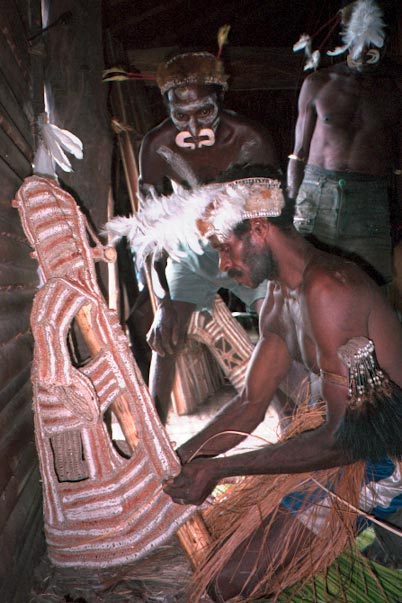
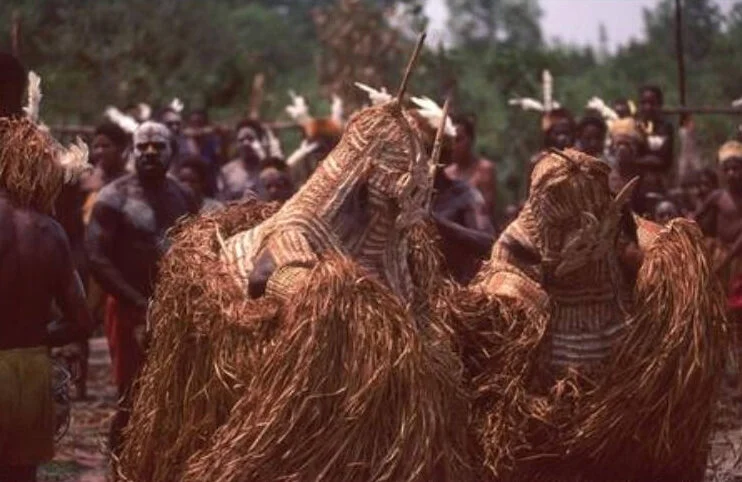
The Asmat are internationally renowned as one of the world’s great woodcarving cultures. Working without metal tools for most of their history, master carvers known as wow ipits produce towering bisj ancestor poles, ceremonial shields, drums, and jipae body masks. Each piece serves a spiritual purpose, honoring deceased relatives and easing their journey to Safan, the ancestral realm beyond the western sea. Asmat cosmology holds that death is never natural; it must be answered through ritual to restore equilibrium. Carved imagery, often featuring the praying mantis and the black king cockatoo, encodes this belief that humans, ancestors, and the natural world are bound in continuous reciprocity.
Traditional Jipae Body Mask
Contact and Contemporary Life
 Sustained outside contact began only in the 1950s with Dutch colonial administrators and Catholic missionaries. The 1961 disappearance of Michael Rockefeller while collecting Asmat art brought global attention to the region. Today the Asmat navigate the pressures of logging, mining, and modernization while continuing to revitalize their carving traditions, language, and ceremonies as enduring expressions of cultural identity.
Tribal Ghost Dance of the Asmat in traditional Jipae Body Masks