The Word of the Buddha in Folded Form
Folded Paper Books of the Pali Canon: History and Significance
The Word of the Buddha in Folded Form
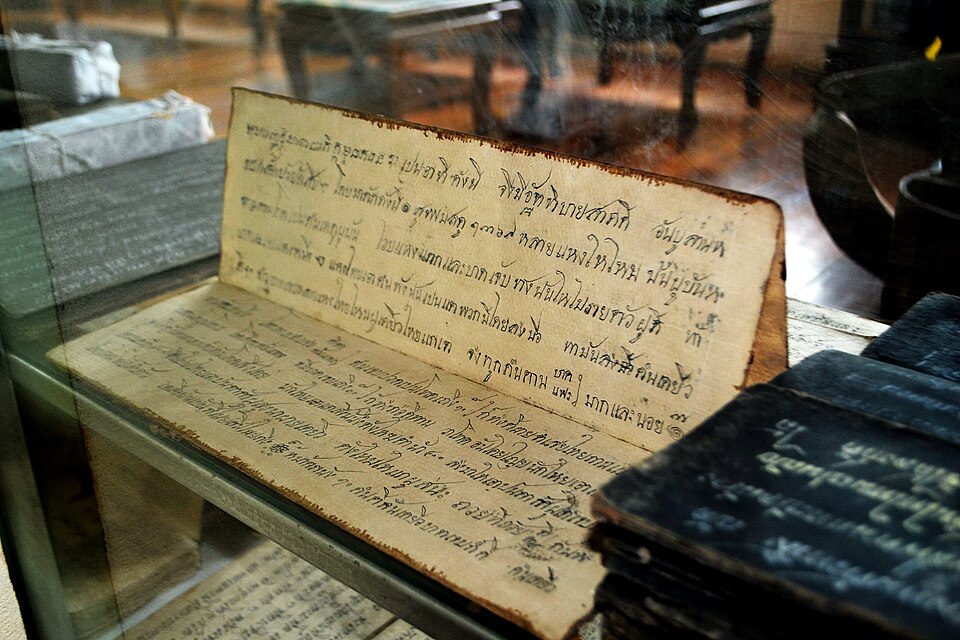 Across the Theravada Buddhist cultures of mainland Southeast Asia, the teachings of the Buddha have for centuries been preserved in two great manuscript traditions. The first uses inscribed palm leaves bound between wooden covers; the second, distinctive to the region, uses long folded paper books known in Thailand as samut khoi, in Burma as parabaik, and in Laos as nangsue boek. Made by gluing sheets of paper end to end into a single continuous strip, the strip is then folded accordion-style to form a compact rectangular volume that opens like a fan. These books became the preferred vehicle for recording the Pali canon, ritual handbooks, royal chronicles, astrological treatises, and works of literature throughout Thailand, Burma, Laos, and Cambodia.
Materials and Production
The paper itself, called khoi paper in Thailand, is made from the bark of the streblus asper or paper mulberry tree. The inner bark is soaked, beaten to a pulp, mixed with water, and spread on cloth-covered frames to dry into long sheets of remarkable durability. White khoi paper provides a bright surface for ink-and-gold manuscripts, while a black version coated with lampblack and rice paste yields a deep matte ground on which scribes write with white steatite or yellow orpiment ink. A finished volume may stretch many meters when fully unfolded, with each panel containing several columns of finely written script in Khom, Mon, Burmese, or Lao characters depending on the region of origin.
The Pali Canon and Its Texts
The Pali canon, known as the Tipitaka or Three Baskets, is the oldest complete collection of Buddhist scriptures, comprising the Vinaya Pitaka of monastic discipline, the Sutta Pitaka of the Buddha’s discourses, and the Abhidhamma Pitaka of philosophical analysis. Folded paper books rarely reproduce the entire canon in a single set, since the complete Tipitaka is enormous; rather, they preserve specific texts of great devotional or liturgical importance, including the Phra Malai poems, the ten great jataka tales of the Buddha’s previous lives, the Abhidhamma summaries chanted at funerals, and protective scriptures known as paritta. Coping these texts was to make immense merit, and royal and aristocratic patrons sponsored elaborately illustrated editions for presentations to monasteries.
Illumination and Significance
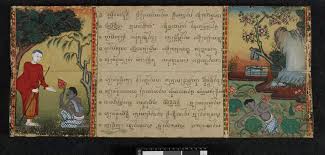
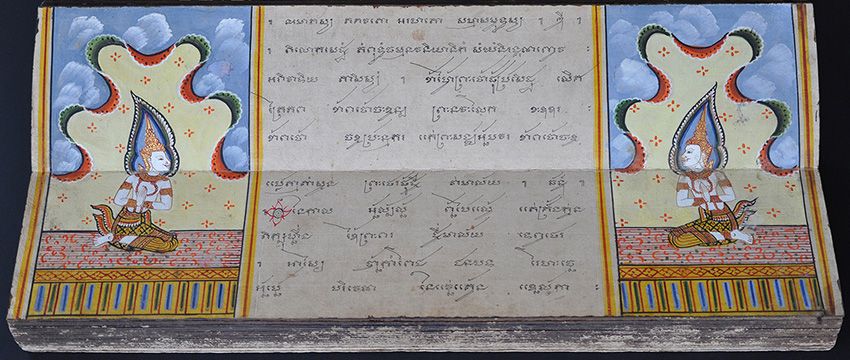 The most splendid samut khoi are richly illuminated. Painters working alongside scribes added scenes from the life of the Buddha, episodes from the jataka tales, depictions of the heavens and hells, and decorative borders of celestial beings, flowers, and flame motifs. Pigments derived from minerals and plants, with frequent use of gold leaf, give these books a luminous beauty equal to any panel painting of their era. Today fine examples are preserved in monastic libraries, the National Library of Thailand, the British Library, and major museums worldwide. As both sacred text and luminous artwork, the folded paper book remains one of the great achievements of Southeast Asian Buddhist culture.