Container of the Dharma
The Sadaik: A Buddhist Manuscript Chest from Thailand
Container of the Dharma
In the Theravada Buddhist cultures of mainland Southeast Asia, sacred scriptures were never simply books. They were the literal embodiment of the Buddha’s teaching, carriers of the dharma, and as such they demanded protection of the highest order. The sadaik, known in Thailand as a hip phra tham and across the border in Burma as a sadaik chest, was the elaborate wooden cabinet or coffer crafted to house bundles of palm-leaf manuscripts and folded paper books containing the Pali canon. To donate a sadaik to a monastery was considered an act of profound merit, ensuring the patron favorable rebirth and earning communal honor in this life. As a result, sadaik are among the most splendidly decorated furnishings in Southeast Asian Buddhist art.
 Origins and Tradition
The tradition of monastic libraries took shape in Thailand during the Sukhothai and Ayutthaya periods between the thirteenth and eighteenth centuries, when Theravada Buddhism became the established religion of the kingdom and royal patrons commissioned ever larger numbers of scriptural copies. Manuscripts inscribed on dried palm leaves with a stylus, then rubbed with lampblack to reveal the script, were bound into bundles and stored together with folded paper books known as samut khoi made from mulberry-fiber paper. To preserve them from the tropical climate, insects, and rodents, monasteries built dedicated manuscript halls called ho trai, often raised on stilts above ponds, and within these halls the manuscripts were arranged in great chests of varying sizes. The most magnificent surviving examples come from the Ayutthaya and early Bangkok periods.
From the Collection of Manuscript Chests at Primitive – Chicago
Form and Decoration
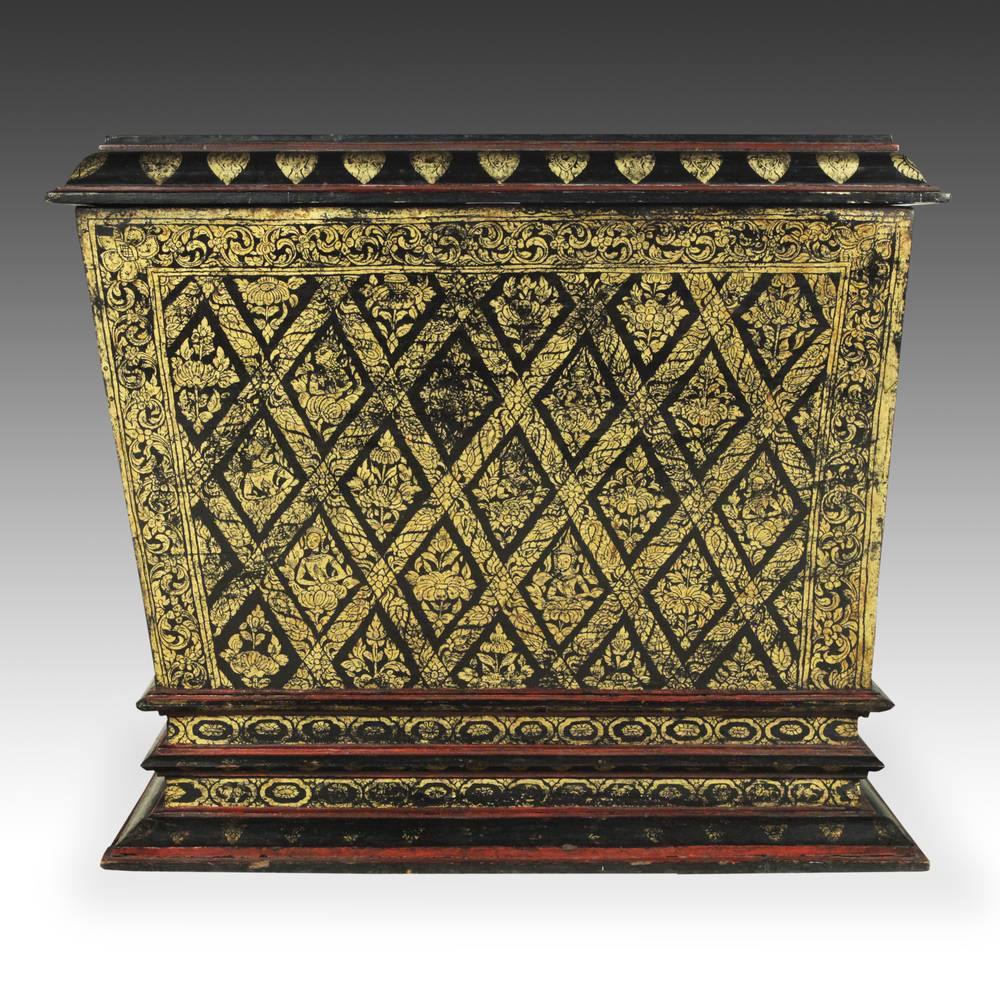
A sadaik typically takes the form of a tall rectangular chest with a sloping or stepped base, sometimes with curved cabriole legs that lift it above the floor. The wooden carcass, usually teak or jackfruit wood, is finished with thick layers of black lacquer that seal and protect the surface. The most famous Thai sadaik are then decorated using the lai rot nam technique, an exquisite gold-and-black craft in which the artist paints designs on the lacquer surface with gum, gilds the entire panel with gold leaf, and finally washes the work to reveal gilded imagery against a glowing black ground. Subjects include scenes from the life of the Buddha, the jataka tales of his previous lives, processions of celestial beings, the heavens of Mount Meru, and intricate floral and flame patterns. Mother-of-pearl inlay and glass mosaic offer alternative ornamental traditions.
Significance
Today the finest sadaik are preserved in Thai monastic libraries, the National Museum in Bangkok, and major international collections. They stand as testaments to a culture in which beauty, faith, and the protection of knowledge were inseparable, and in which the act of housing the Buddha’s words was itself an offering worthy of the most accomplished hands.