Architectural Screens & Dividers
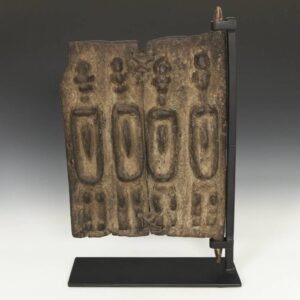
A lattice, a late afternoon, a room half seen through carved wood. Antique screens and dividers, shutters included, come from China, India, Tibet, Japan, Indonesia, the Philippines, Morocco and West Africa. Chinese elm and camphor wood screens are cut in open lattice, often in four-panel sets with stylized geometric or floral grids; doors with Buddhist iconography and dragons in clouds come from Tibet and western China. British colonial shutters from India, hinged in pairs, keep fixed louvers and old paint. Stained glass panels, Japanese wood screens and Moroccan carved panels bring other patterns of light. From Nigeria and Mali, Nupe, Yoruba and Dogon carved panels divided space in their own way. Most date from the nineteenth and twentieth centuries.
A lattice screen breaks a long room without closing it and throws patterned shadow across the floor. Against bare brick, a pair of shutters has the depth of a wall relief. Privacy, with better lighting.
Showing the single result