The Bodhisattva of Compassion
Avalokiteshvara Flanked by Attendants with Dhyani Buddhas in Mandorla
The Bodhisattva of Compassion
Avalokiteshvara, whose Sanskrit name means “the lord who looks down with compassion,” is the most beloved bodhisattva in the Mahayana and Vajrayana Buddhist traditions. Known in Tibet as Chenrezig, in China as Guanyin, and in Japan as Kannon, he embodies the limitless compassion of all the Buddhas and vows to remain in the world until every sentient being is liberated from suffering. He is regarded as the spiritual patron of Tibet, and the Dalai Lamas are venerated as his earthly emanations. Across the Himalayan world he appears in countless forms, from the simple two-armed Padmapani holding a lotus to the awe-inspiring eleven-headed and thousand-armed Sahasrabhuja, each pair of arms reaching out to relieve a different form of suffering.
The Triadic Composition
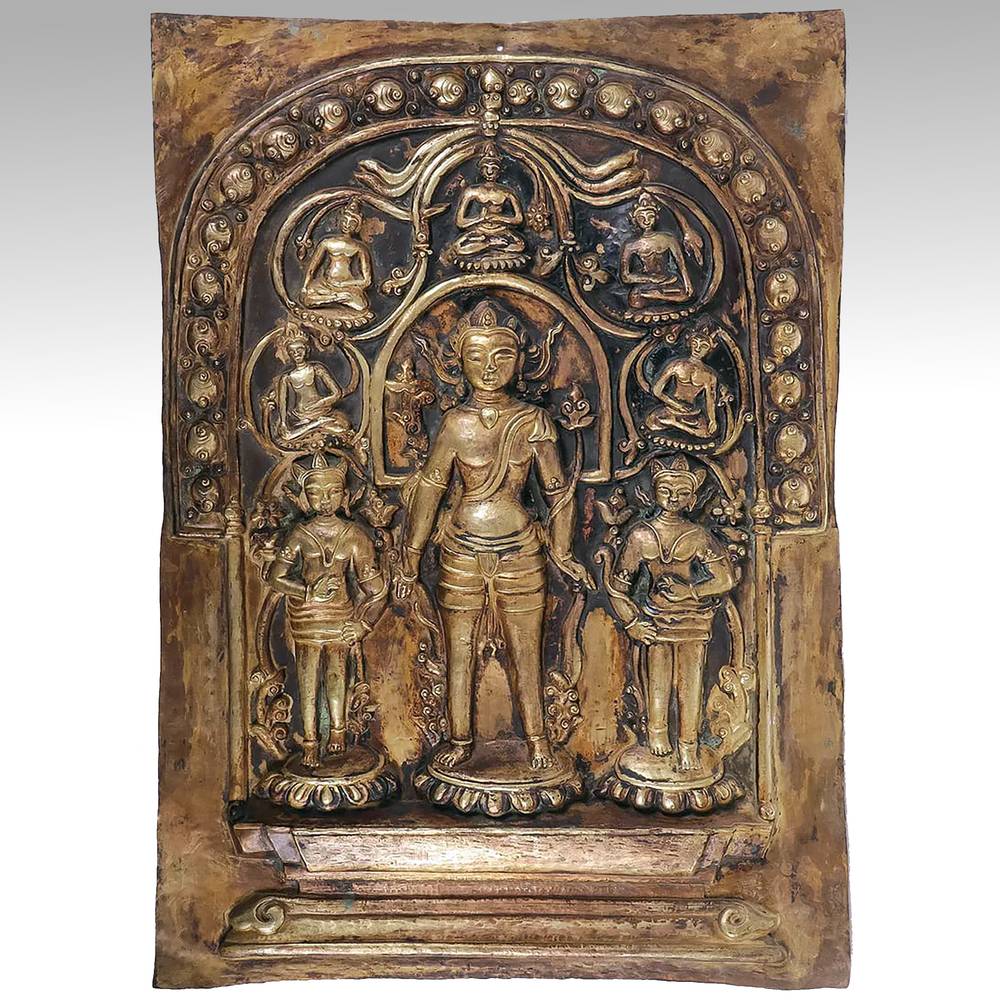 A particularly important compositional formula in Nepalese and Tibetan sacred art depicts Avalokiteshvara at the center, flanked on either side by two attendant bodhisattvas. The most common attendants are the green Tara, swift savioress and embodiment of enlightened activity, and the white Tara, who confers long life and healing. In some compositions the attendants are instead Manjushri, holding the flaming sword of wisdom, and Vajrapani, wielding the thunderbolt scepter of skillful means. Together with the central Avalokiteshvara, these triads express the three essential qualities of awakening: compassion at the center, wisdom on one side, and the power to act on the other. Such groupings are known in Tibetan as the Rigsum Gonpo, the lords of the three families.
The Mandorla and the Five Dhyani Buddhas
The central figure is typically enclosed within a mandorla, the almond-shaped halo of light that surrounds the entire body of an enlightened being and signifies the radiance of his realization. Around this mandorla, fine examples display the five Dhyani Buddhas, also known as the Tathagatas or Jinas, the cosmic Buddhas who govern the five wisdoms and the five elements. They are Vairochana at the center, white in color and embodying the wisdom of the dharma realm; Akshobhya in the east, blue and embodying mirror-like wisdom; Ratnasambhava 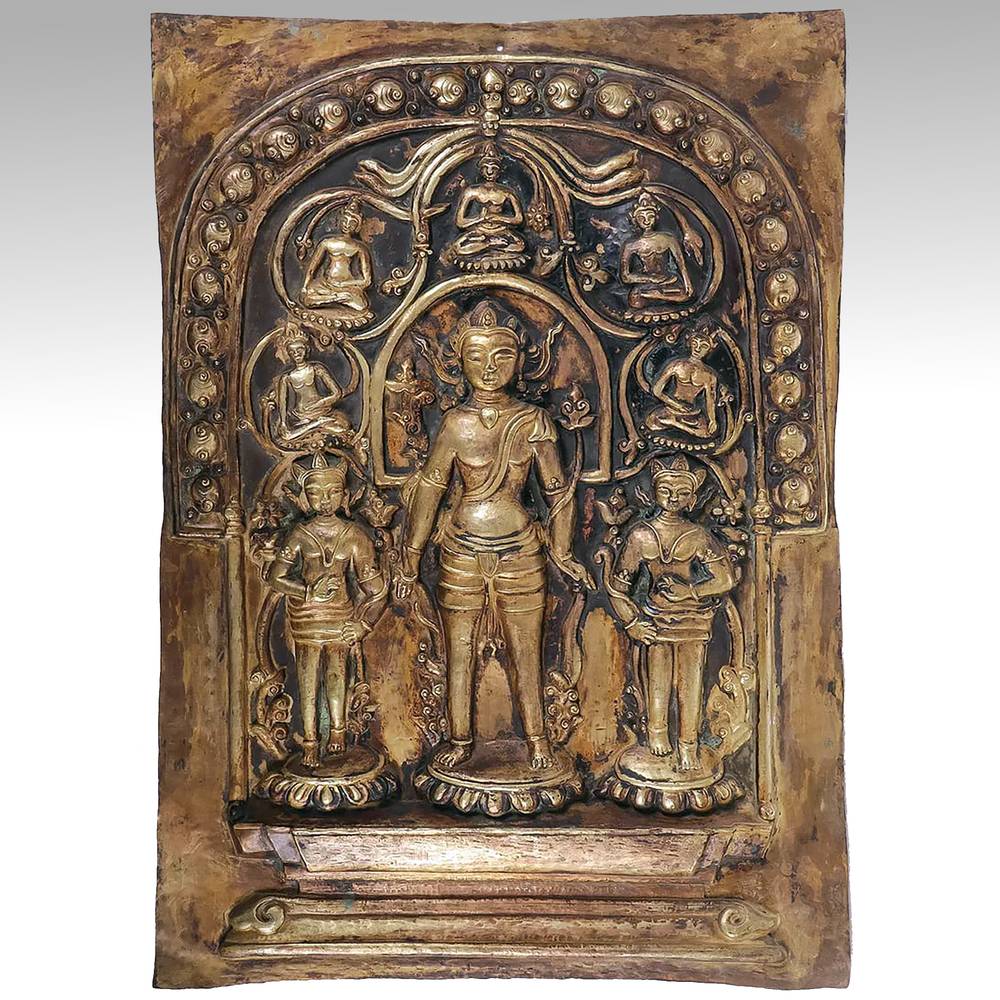 in the south, yellow and embodying the wisdom of equality; Amitabha in the west, red and embodying discriminating wisdom; and Amoghasiddhi in the north, green and embodying all-accomplishing wisdom. Their presence around Avalokiteshvara reveals that compassion is not separate from wisdom but is its luminous expression. Notably, Avalokiteshvara himself is regarded as an emanation of Amitabha, who often appears as a small, seated Buddha in his crown.
From the Collection of Repousse Art at Primitive – Chicago
Significance
Whether rendered in cast bronze, gilded repoussé copper, or painted thangka, this iconographic formula offers the viewer a complete cosmological map. The triadic composition with mandorla and five Dhyani Buddhas remains one of the most enduring and meaningful images of Himalayan Buddhism, sustaining devotion and meditation across centuries.