The Healing Buddha
The Medicine Buddha: History and Significance
The Healing Buddha
 The Medicine Buddha, known in Sanskrit as Bhaisajyaguru, in Tibetan as Sangye Menla, and in Chinese as Yaoshi Fo, is one of the most beloved figures in the Mahayana and Vajrayana Buddhist traditions. He is venerated as the supreme physician of body, mind, and spirit, embodying the conviction at the heart of Buddhist teaching that suffering itself is a kind of illness and that the dharma is the medicine that heals it. Worshipped from India and Tibet across China, Korea, Japan, and the wider Buddhist world, the Medicine Buddha occupies a place of singular importance wherever Buddhists turn to spiritual practice in times of physical illness, mental anguish, or approaching death.
Origins and Scriptural Source
The figure of the Medicine Buddha first appears in the Bhaisajyaguru Sutra, an Indian Mahayana scripture composed around the second to fourth centuries CE. The sutra describes a previous lifetime in which Bhaisajyaguru, then a bodhisattva, made twelve great vows to relieve the sufferings of sentient beings. Among these were promises to cure all sickness, to provide nourishment to the hungry, to free the imprisoned, to grant rebirth in his pure realm to those who call on him, and to ensure that women who wished could be reborn in male form, a vow reflecting the social conditions of the era. The text was translated into Chinese as early as the fourth century and rapidly gained popularity throughout East Asia, where it became the foundation for an entire tradition of healing rituals and chanting practices.
Iconography
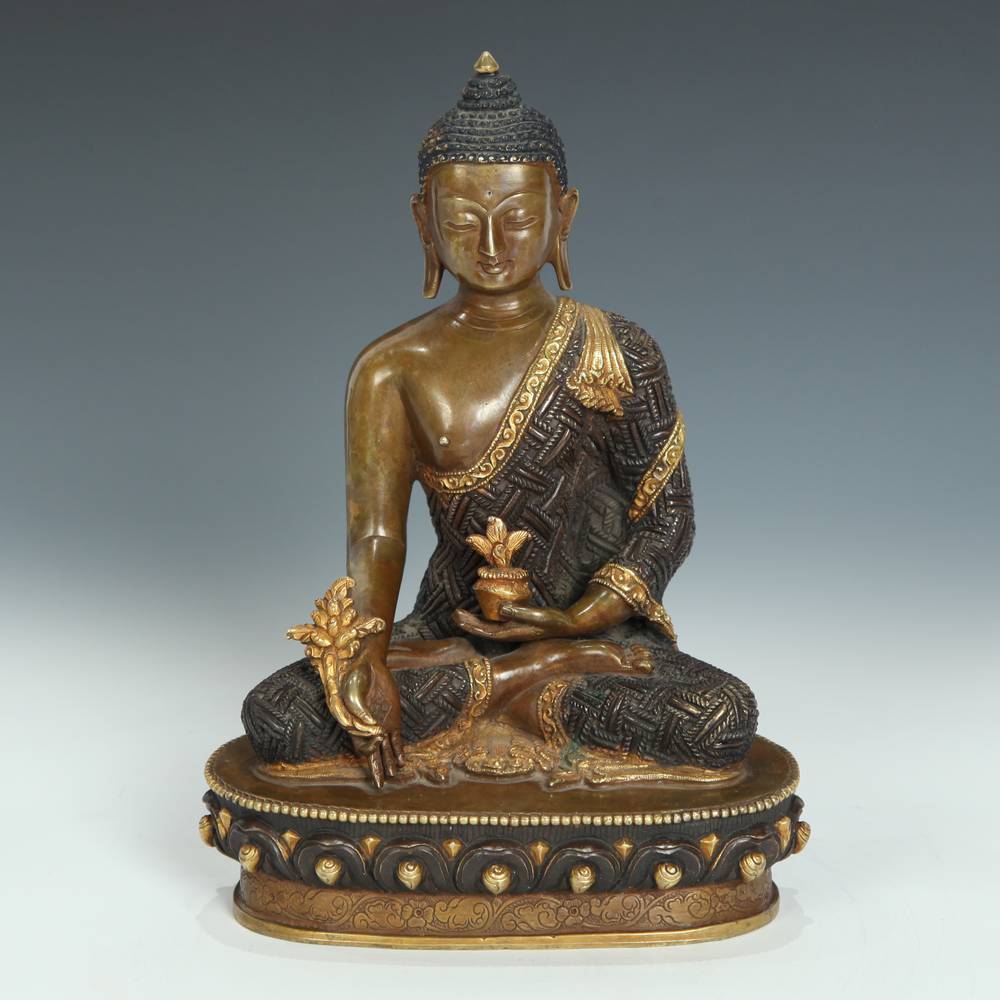
The Medicine Buddha is most often depicted seated in lotus posture upon a lotus throne, his body the deep blue color of lapis lazuli, a hue regarded as both healing and pure. His left hand rests in his lap holding an alms bowl filled with the elixir of immortality and a stalk of the myrobalan plant, an Ayurvedic medicinal fruit considered the king of healing herbs. His right hand extends downward in the gesture of supreme generosity, palm outward, often holding the same myrobalan branch. He wears the simple monastic robes of a Buddha and is frequently flanked by attendant bodhisattvas of sunlight and moonlight. In Tibetan tradition he is often shown at the center of an assembly of seven or eight Medicine Buddhas, each presiding over a different domain of healing.
Practice and Significance
Devotion to the Medicine Buddha takes many forms across the Buddhist world. Practitioners chant his mantra, tayata om bekandze bekandze maha bekandze radza samudgate soha, recite his sutra, visualize his radiant blue form, and bless water and medicines in his name to be given to the sick. In Tibet, the Medicine Buddha lineage is also closely linked to the development of Sowa Rigpa, the traditional Tibetan medical system, whose practitioners regard him as their spiritual source. As both a focus of compassionate prayer and a model of the healing path, the Medicine Buddha continues to bring comfort, courage, and wholeness to countless devotees today.