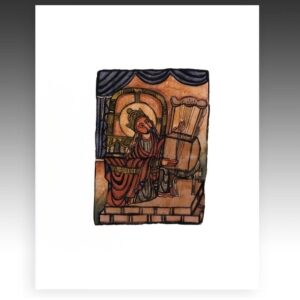
Lithographs
Munich, 1798. A Bavarian playwright, short of money for printing his plays, discovers that oil and water will not mix on a slab of limestone.
Lithographs follow from Alois Senefelder’s trick: draw in greasy crayon or ink on stone, then ink and print it, letting oil and water do the sorting. Delacroix, Goya, Picasso and Matisse all took it up. Color lithographs of the late nineteenth century needed a separate stone for each hue. The technique appears in Cultural Revolution suites from China, such as the color lithograph set Be Prepared, as well as in European and contemporary editions.
The grain is soft and crayon-like; the color lies flat. Simple frames suit it.
A playwright’s accident, then, still hanging in a hallway.
Showing the single result