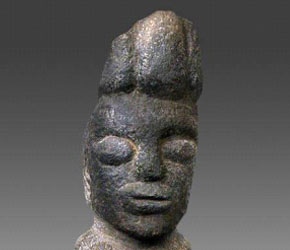
Considered by many to be the cradle of civilization, Africa is just beginning to yield some of its archeological secrets to our modern age. As recently as the early 1960s, 295 carved stone boulders or monoliths where discovered at 39 ritual sites in an area northwest of Ikom in the Cross River area, which spans the border between southeastern Nigeria and southwestern Cameroon. The stones were arrayed mostly in circular groups facing each other. The monoliths were one to six feet high and carved from native basalt or volcanic rock. Other sites were subsequently discovered.
The Ejagham people, who live in this region, called them Akwanshi , which translates as “person in the ground.” There is general agreement among scholars that they are memorials for the ancestors; however, there are those who make a compelling case that these stones are related to astronomical as well as religious activities. In this regard, they may be akin to the great monoliths found at Stonehenge and similar sites scattered across just about every other continent.
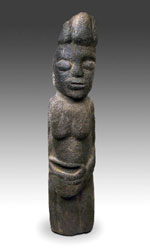
There is great debate about the actual age of the pieces. Some believe the monoliths date as far back as the early 16th century, while another source claims they are 4,000 years old. A piece at the Museum of Fine Arts in Boston is dated to the 19th Century.
Present-day boundaries have little relevance when one considers the amount of time that has elapsed since the creation of these monoliths, whether it is 100, 500 or 4,000 years. Even now, the names of tribal groups, the countries they live in and their ethnographic as well as political boundaries have to be constantly updated.
While there are more questions than answers about these striking stone carvings, their visual power and spiritual resonance serve as a reminder that highly developed cultures preceded us in Africa. These so-called primitive peoples left evidence of their military, social and religious lives, their tribal struggles, collective spiritual aspirations, and most importantly, their ancestral past. In Akwanshi they left an evocative legacy, bequeathing to us the idea that certain mysteries may endure.
Download this Article: {module_literature,i,138665}