Medicine Cabinets
A Chinese herbalist’s shop, the eighteenth century. Somewhere behind the counter is a wall of tiny drawers, and he knows every one by heart.
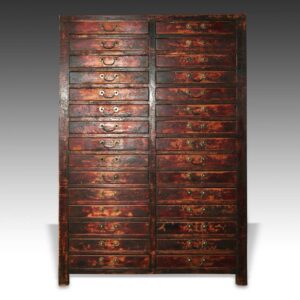
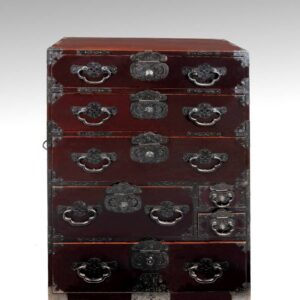
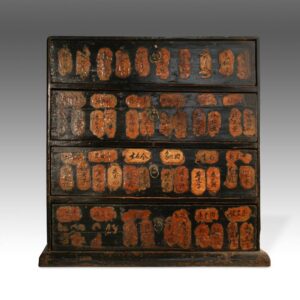
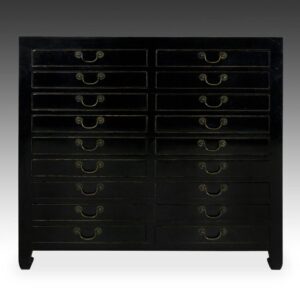
Antique medicine cabinets and apothecary chests are the working furniture of Chinese herbalists, made in elm, pine and walnut in the eighteenth and nineteenth centuries and fitted with rows of small drawers. Handwritten labels name the roots, barks and minerals inside. Some combine drawers and doors, or place medicine compartments below bookcase shelves. Japanese kusuri dansu with ornate hardware and the Tibetan pegam cabinet turn the same idea to other forms. The grid of drawer fronts, each with a bronze pull, makes a strong graphic rhythm.
Still practical: flatware in a dining room, spices in a kitchen, stationery in a study.
Cures for most things, or at least a place to put them.
In the collection now: Japanese 7 Drawer Tansu with Ornate Hardware, Chinese Storage and Apothecary Cabinet with 18 Drawers, and Chinese Apothecary Cabinet with 4 Drawers.
Showing all 4 results